We Read 191 Starter Story Founder Interviews. Here Is What Actually Got Them Customers
We pulled the transcript of every long-form Starter Story video and logged how each founder found customers. 69% grew mainly through organic channels, 9% through ads, and the best channel depends on what you sell. Search, short video, creators, X, Reddit, pricing, and what did not work.
00:18:00 · OCT 16, 2026

The short version
- 69% of founders grew mainly through organic channels. 9% grew mainly through ads.
- 63% credit one single main channel.
- The right channel depends on what you sell: short video for apps, search for SaaS, X for AI tools.
- Small, specific content beat viral content. A 370-view video brought 3 customers; an 11.6-million-view video brought almost none.
- The ads that worked were pushing a format that had already worked for free.
What we did
Starter Story interviews founders about how they built their businesses. Its channel has 547 uploads: 192 long-form interviews and 355 Shorts. Watching the interviews would take days, and you would forget most of them by the end. So we read them instead.
- Listed every upload and pulled the transcript of each long-form interview with our own tool. All 192 took 6.7 minutes. 191 had captions.
- Had an AI model read each transcript and fill in the same fields every time: what the business sells, stated revenue, every growth channel with the exact tactic and result, how the first customers came, pricing, and what failed.
- Counted the patterns across all 191, then checked every example below against those notes.
Two warnings before the numbers. Every revenue figure is what a founder said on camera, not something we verified. And Starter Story features winners, so the founders who tried the same tactics and failed are not in the data.
Most founders grew without ads
179 of the 191 founders named at least one main channel. A founder can name more than one, so the counts overlap.
69%
grew mainly through organic channels
124 of 179 founders
9%
grew mainly through paid ads
16 of 179 founders
63%
credit one single main channel
113 of 179 founders
41%
were solo founders
78 of 191 founders
Main growth channel named by founders
- X / Twitter25
- SEO23
- Short video22
- Paid creators19
- Reddit17
- YouTube16
- Paid ads16
- Word of mouth15
- Building in public13
- Email list10
Only 16 founders named paid ads as a main channel, and just 9 named nothing else.
The channel depends on what you sell
Split by type of business, the picture changes completely. There is no best channel, only the best channel for a kind of product.
Which channel works depends on what you sell
| Mobile apps(50) | SaaS(54) | AI tools(26) | Agencies, creators, info(35) | |
|---|---|---|---|---|
| Short video | 32% | 2% | 12% | 0% |
| Paid creators | 28% | 0% | 8% | 0% |
| SEO | 2% | 24% | 12% | 9% |
| 4% | 15% | 15% | 6% | |
| X / Twitter | 4% | 6% | 19% | 26% |
| YouTube | 0% | 11% | 0% | 23% |
| Building in public | 2% | 11% | 15% | 6% |
| Word of mouth | 2% | 11% | 8% | 11% |
| Email list | 2% | 2% | 4% | 17% |
| Paid ads | 16% | 6% | 8% | 3% |
Apps that show something fun in a few seconds spread through short video. Software people go looking for gets found through search. AI tools, bought by early adopters, spread on X. People who sell their own expertise build an audience on X, YouTube and email. Developer tools and browser extensions had only 7 interviews between them, too few to call.
Ads came second, and the winners followed rules
The founders who won with ads mostly found their winner organically first, then paid to show it to more people.
- This Stupidly Simple App Makes $100K/Month: made 10 TikToks a day for about a month until one format worked, then put ads behind it. Stated: from $30K to over $100K a month.
- The $1M Mobile App Playbook: turned the best organic TikToks into ads. Stated: about $20 to $24 per customer against a lifetime value of $55 to $70.
The rules they described:
- Optimise for the event that makes money (a subscription, not an install), spend at least $50 a day, run at least 6 videos per campaign, and raise the budget by no more than 20% every 3 days (I Make $50K Per Month Working 5 Hours A Week).
- Make 10 to 20 versions of one format and kill the losers. Stated: about $16 per subscription against a lifetime value of $30 to $35 (The Lazy Method).
Even done well, the margin is thin. I Built a $100K/Month Android App states almost $500,000 spent on Google app ads with revenue from them about equal to the spend. Ads make a working thing bigger. They rarely find the working thing.
One channel, done properly
Almost two thirds of founders credit one main channel. The ones who explain it do not describe a little of everything. They describe one channel they went deep on until it worked, and only then added a second.
For a small team this is mostly about time. Ten channels at an hour a week each means none of them gets good.
Search: small pages, comparison pages and free tools
SEO was the second most common main channel overall and the first for SaaS. The founders who gave details did not chase big keywords.
One page per exact problem
- Zero to $40K/Month With One Marketing Channel: in-depth guides for bottom-of-funnel keywords with 300 to 800 searches a month. Stated: more than $8K MRR from organic search.
- How I Built a $13K/Month SaaS: support articles ranked by accident, then keyword research limited to difficulty under 20. Stated: about $70,000 from Google in 2023.
- This App Makes $25,000/Month: documentation for very niche searches, then more of whatever people clicked. Stated: about half of 86,000 monthly visitors come from Google.
Pages about your competitors
- I Built A Micro-Version Of A $1B SaaS targeted searches like "alternatives to [competitor]" and "how much does [competitor] cost".
- I rebuilt a $1B app and now make $14K/month searched for "Skype alternative", found the articles already ranking, and asked their authors to add his product. Some did.
- How This $250K/Month SaaS Got Its First 100 Users built a comparison page against every competitor, then improved the ones AI assistants cited.
Free tools that lead to the product
- How I Grew My App to $13K/month: about 50 small free tools, each with a call to action. Stated: about 50,000 Google clicks a month, almost 90% from the tools.
- How This $250K/Month SaaS Got Its First 100 Users: dozens of free tools with no sign-up. Stated: about 20% of all traffic, and 15 to 20% of those visitors sign up.
- I Built a $1M AI App [No Code]: a free Excel formula generator came before any paywall. Stated: about 750,000 users, about 5,000 of them paying.
The catch: the 50-tool founder also states only about 300 leads. Traffic is the easy part. Visitors who need the product are the hard part.
AI assistants are a new search engine
Several founders now see visitors from ChatGPT and other assistants. The $13K/month SaaS above says those visitors buy quickly. The $250K/month SaaS states 30 to 40% of visitors come from search and AI assistants combined. And How Postiz Went From $17K to $143K/Month in 4 Months published a plain description of its API written for AI agents and listed it in the Claude and ChatGPT marketplaces, which he says brought a lot of traffic. Nobody gave a number for revenue from AI answers yet.
Small YouTube videos sold more than big viral ones
This was the most surprising pattern. View counts and sales barely moved together.
Views are not sales
Small video, specific problem
370 views
brought 3 customers
1,800 views
brought 80% of a launch's revenue
Big viral video
11.6M views
brought almost no installs
120K views
brought about 8 or 9 trials
- How I Built a $12K/Month Micro-SaaS: a video with 370 views brought 3 customers, because everyone who found it had the exact problem it solved.
- I Make $250K/Month From 13 Businesses: 80% of a launch's revenue came from a YouTube video with 1,800 views. The launch tweet had about 30,000 views and brought 20%.
- I Make $17K/Month With One Strategy: a plain 20-minute video with a clear, searchable title ranked first for its query on YouTube.
The other side: in The $1M Mobile App Playbook, a video with 11.6 million views brought almost no installs, because it had no call to action and did not show the problem. A video that answers a search beats a video that goes viral.
Short video: copy a format that already works
For apps, short video was the top channel. The method was the same almost every time: find videos in your niche that already went viral, copy the structure, change the hook, post every day, and keep whatever gets comments asking for the app.
- Our simple app made $100K in 90 days: one video a day, close copies of viral videos in the niche. Stated: about 9 million views and about 250,000 sign-ups.
- This Stupidly Simple App Makes $100K/Month: 10 videos a day for a month until one format, replying to comments, took off. Stated: first sale within 2 days of launch.
Views still are not sales. In I Built a $10K/Month App With This One System, a slideshow with 120,000 views brought about 8 or 9 trials.
Small creators beat big influencers
Paying creators was common for apps, and cheap deals with small creators did better than expensive ones with big names.
- My 2 apps made $1.5M: paid a small streamer about $120 for a video showing the app working. Stated: 2 million views. He picked creators from nearby niches, not the same niche.
- He Made $10M with 3 iPhone Apps: two small creators at $50 each. Stated: 45,000 downloads on the first big day. Messages to big influencers got no replies.
- I'm 14 And I Built A $14K/Month App: paid per deal with a minimum view count written in. Stated: an $800 video estimated at about $3,000 in revenue.
- This Insanely Simple App Makes $50K/Month: paid on a view guarantee at about $2 to $3 per 1,000 views.
It also failed often. Our simple app made $100K in 90 days dropped paid influencers after some views and almost no sales, and The Lazy Method dropped creators because he could not tell which one brought which sale.
X: show the product working in 20 seconds
X was the most common main channel overall. The posts that worked were short demos and honest build updates, not announcements.
- How I Built A $1M Business in 117 Days: his third tweet ever was a demo that shows the value in about 20 seconds, naming the tools he used so those companies shared it. Stated: it went viral, then 2 to 3 sales a day.
- How I Used Twitter to Hit $10K/Month: on the same day, a selfie post beat his screen-recording launch post. Stated: 46,000 views and more sign-ups, against 32,000 views and 26 sign-ups.
- I Built an App with Cursor, Made $30K, and Quit My Job: tied a demo to a live debate ("is AI coding good enough to build a SaaS?"). Stated: close to 500,000 impressions on the best post.
- How Postiz Went From $17K to $143K/Month: long X articles on a trending topic. Stated: about 500,000 views on the first one, with about 200 followers.
Reddit: answer questions for weeks before you post
Reddit produced some of the best launch stories and the most bans. The difference was patience.
- How I Used Reddit To Build a $25K/Month Business: watched the target subreddit for weeks, answered in its weekly thread, and asked the moderators before making a top-level post. He also set up keyword alerts so he could reply whenever his topic came up.
- How I Built It: $20K/Month AI App as a Non-Technical Founder: one long resume guide, posted in 2018. Stated: about 20,000 questions answered on it over 6 years, and it became the top Google result for its topic.
- This App Makes $25,000/Month: one post per small niche subreddit, asking for feedback, with no prices on the site. A 58-upvote post brought the first paying customers.
Several others had posts removed or were blocked after a few posts, usually after posting links to their own product.
Word of mouth was built into the product
The founders who named word of mouth did not wait for it. They built a reason to share into the product.
- I built this website in 8 hours with Claude: a daily game with a shareable score. Stated: 53% of players share, and about 98% of daily traffic comes from players.
- I Made $1.5M From An App You've Never Heard Of: a referral reward that pays out only when the referred person pays. Stated: about 200 paying users in the first month.
- This App Makes $25,000/Month: a free tier that freelancers bring to events, where the people watching see the product.
An email list beat launch day
Product Hunt came up in 15 interviews, and only once as a main channel. Several founders said a launch brought traffic and no paying customers. How I Built It: $37K/Month Notion App got not a single sale from it, and I Built a $100K/Month Android App got 2 subscribers.
The launches that worked had people behind them. How I Made $65K in 3 Days launched on Product Hunt after its first buyers had become fans who shared it. Stated: Product of the Week and about 50 new customers. I Built a Niche App to $9K MRR credits a front-page Show HN post, a developer tool shown to developers.
A list did the job more reliably. How I Built It: $30K/month Micro-SaaS (Subscribr Breakdown) built an email list of over 1,000 people, sent a 7-day pre-sale sequence, and sold 50 lifetime licences in 2 to 3 days for about $20,000 (stated), before the product was finished.
Pricing: charge early, and more than you think
Free plans and low prices
- How I Built It: $9K/Month Micro-SaaS: removing the free plan angered some users, and revenue went from about $5K to $8K a month.
- How I Built It: $12K/Month Micro SaaS: started at $5 a month, found it left almost no margin, and raised prices.
- How I Built It: $37K/Month Notion App: price increases did not change conversion, and higher plans added revenue.
Trials and yearly plans
- How I Built It: $17K/Month Open Source SaaS: stated 21% of 3,830 trials became paying customers.
- Our Mobile App Made $85K in 8 months: $40 a year with a 3-day trial, or $10 a month with no trial. The trial only comes with the yearly plan.
- This Insanely Simple App Makes $50K/Month: $29.99 a year or $9.99 a month. A year costs about the same as three months.
- I'm 14 And I Built A $14K/Month App: anyone who closes the $40-a-year offer is shown $20 a year instead.
Yearly plans in the data were usually far cheaper than twelve monthly payments, often a third to three quarters off. Founders used them to keep people who would otherwise cancel after the first month.
A yearly plan often cost a quarter to a third of paying monthly
- $29.99/year vs $9.99/monthThis Insanely Simple App Makes $50K/Month25%
- $30/year vs $10/monthHow We Built This $20K/Month AI App25%
- $40/year vs $10/monthOur Mobile App Made $85K in 8 months33%
- $45/year vs $10/monthI Built A $30K/Month in 35 Days38%
- 100% would mean the yearly plan costs the same as paying monthly for a year.
Credits for APIs
I Found a Business for Sale and Rebuilt It Into $20K/Month sells a scraping API as prepaid credit packs: $10 for 5,000, $50 for 25,000, $500 for 500,000. He states about 12 customers make up most of the revenue, and he finds users by commenting on launch videos in his niche with an offer of 10,000 credits to try it. For an API, a few large buyers matter more than many small ones.
Affiliates: two partners can be enough
In I Built a $10K/Month SaaS Using Other People's Customers, the founder paid a 30% lifetime commission to coaches who already sold to his kind of customer. Stated: most growth came from two of them, and he reached $10K a month in the third or fourth month. The lesson is to recruit the few people who already have your buyers, not to open a program and wait.
The cheapest tactic: talk to the people who pay
In I Built 4 SaaS Apps to $100K MRR, the support link on each product pointed to the founder's Twitter DMs until the product reached $10K a month. Users wrote to him directly and he fixed problems within minutes.
In How I Built It: $12K/Month Micro SaaS, the founder emailed people who cancelled with one yes or no question. They answered. The reason field in his cancellation pop-up had told him nothing useful.
What did not work
- Viral videos without a call to action or a clear problem.
- Launch days with no audience or early fans behind them.
- Paid influencers before a format had been proven, and big influencers at any point.
- Cold ads for a cheap product. Even the winners reported a cost per customer close to what a customer was worth.
- Free plans, for some. Free users often stayed free and gave little feedback.
- Posting links to your own product in communities. Several founders had posts removed or were blocked.
- Traffic for its own sake. Free tools and viral posts brought visitors who never needed the product.
A 30-day plan from the data
If we had to start a product tomorrow, this is what the interviews say to do.
- Pick one channel from the table above for your type of product. Ignore the rest for a month.
- Charge from day one. Offer a yearly plan at a real discount, and if you offer a trial, attach it to the yearly plan.
- Make the content small and specific: one page or one video per exact problem someone searches for.
- Look for a format that already works in your niche before you make your own.
- Add one reason to share inside the product: a result people want to show, or a referral reward paid on purchase.
- Email or message every paying customer. Ask what they were trying to do.
- Only once something works for free, put money behind it.
How we built this study
Every number in this article came from the GetYouTubeTranscript API
We listed every upload on @starterstory, pulled 192 transcripts and had an AI read them. Fetching all of them took 6.7 minutes. You can point the same two calls at any channel: competitors, lectures, podcasts, your own videos.
- uploads listed
- 547
- uploads listed
- transcripts fetched
- 192
- transcripts fetched
- to fetch them all
- 6.7 min
- to fetch them all
- failed requests
- 0
- failed requests
# 1. List every upload on the channel (paginated)
curl "https://getyoutubetranscript.com/api/v1/channel/videos?channel=@starterstory" \
  -H "x-api-key: $GYT_API_KEY"

# 2. Fetch the transcript of each video
curl "https://getyoutubetranscript.com/api/v1/transcript?v=8xgnm6SynH4" \
-H "x-api-key: $GYT_API_KEY"One credit per transcript. Failed requests are not charged.
What else people use it for
The same transcripts power very different jobs.
Free to use
Share or use this data
Use the infographic and the dataset in your own articles, newsletters and talks. All we ask is a credit and a link to this page.
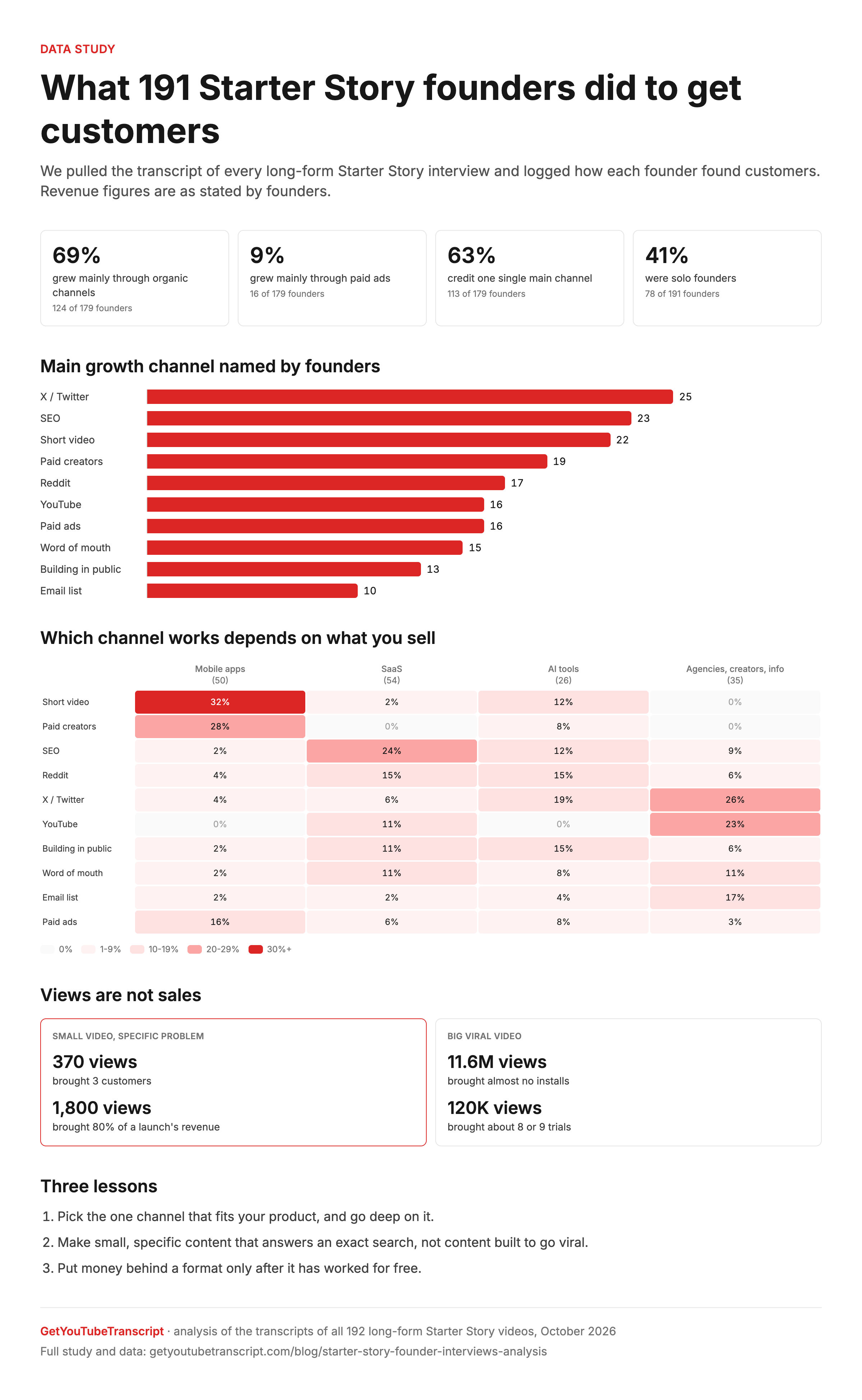
The infographic
Every chart from this study on one page. 2400 x 3896 PNG, sharp on any screen.
Embed it
Paste this into your page. It shows the infographic and credits the source.
<a href="https://getyoutubetranscript.com/blog/starter-story-founder-interviews-analysis"><img src="https://getyoutubetranscript.com/images/blog/starter-story/infographic.png" alt="What 191 Starter Story founders did to get customers (infographic)" width="1200" loading="lazy" style="max-width:100%;height:auto"></a>
<p>Source: <a href="https://getyoutubetranscript.com/blog/starter-story-founder-interviews-analysis">GetYouTubeTranscript analysis of 191 Starter Story founder interviews</a></p>
Get the dataset
191 rows, one per interview, with its link, business type and growth channels.
video_idtitleurlviews_approxbusiness_typemain_channelsall_channelsChannels were tagged by an AI model from the transcripts. Spot-check a row before relying on it.
Download CSVCite this study
For articles, papers and slides.
GetYouTubeTranscript (2026). We Read 191 Starter Story Founder Interviews. Here Is What Actually Got Them Customers. https://getyoutubetranscript.com/blog/starter-story-founder-interviews-analysis
Frequently asked questions
Which Starter Story videos were included?
All 192 long-form videos on the Starter Story YouTube channel as of 16 October 2026. We skipped the 355 Shorts, which are mostly clips of the long videos. One video had no captions on YouTube, so 191 were analysed.
Are the revenue numbers verified?
No. Every revenue, traffic or conversion figure is what a founder said in the interview. We did not check any of them. Starter Story also interviews founders who succeeded, so tactics that failed for other people are under-represented.
How was each interview analysed?
We fetched each transcript with GetYouTubeTranscript, then an AI model read it and filled in the same fields for every video: the business, stated revenue, each growth channel with the exact tactic and result, how the first customers came, pricing, and what failed. The counts in this article come from those fields. Auto-captions sometimes garble names and numbers, so treat counts as close, not exact.
What is the best marketing channel for a SaaS?
In this data, search. SEO was the main channel for 13 of 54 SaaS founders, ahead of Reddit (8). The founders who explained it wrote one page per specific problem on keywords with little competition, and improved the pages that already got clicks.
Do paid ads work for a new product?
Rarely as the first channel. Only 16 of 179 founders named paid ads as a main channel, and the ones who explained their ads had first found a video or format that worked without paying for it. Several stated a cost per customer close to what a customer was worth.
Can I run the same analysis on another channel?
Yes. The channel transcripts tool lets you paste a channel and get the transcripts of the videos you pick in one place, and our MCP server lets an AI assistant such as Claude list a channel and read its transcripts directly. For a script, the transcript API returns one transcript per request.
Related
- How to Get the Transcript of a YouTube Video (Computer, Phone, and Download)
- n8n YouTube Transcript Failing on Your Server? Why YouTube Blocks It and How to Fix It
- YouTube API Quota Exceeded: Causes and Fixes
- YouTube Transcript API Rate Limit: What It Is and How to Handle 429s
- YouTube Transcript MCP Server: Setup Guide for Claude and Other AI Tools
- YouTube Transcripts in n8n: HTTP Request Workflow Guide
- Migrating from Supadata: A Field Guide
- How to Get YouTube Transcripts in Python
- Migrating from TranscriptAPI.com: A Field Guide
- Build an AI YouTube Video Summarizer with LangChain and Next.js
- How to Build a RAG Pipeline with YouTube Transcripts
- The Best YouTube Transcript APIs in 2026
- GetYouTubeTranscript vs TranscriptAPI
- GetYouTubeTranscript vs youtubetotranscript.com
- GetYouTubeTranscript vs youtube-transcript.io
- GetYouTubeTranscript vs NoteGPT
- GetYouTubeTranscript vs Tactiq
- GetYouTubeTranscript vs Glasp
- GetYouTubeTranscript vs Eightify
- GetYouTubeTranscript vs Supadata
- GetYouTubeTranscript vs DownSub
- GetYouTubeTranscript vs youtubetranscript.dev